Every purchase in a private company starts the same way: the same requirements written out again, the same decision about how to compare the offers, and three proposals held side by side in a spreadsheet.
The private sourcing flow in SourceMagnet has been rebuilt around that, and it arrives with the platform upgrade over the weekend of 4 to 6 September. You compose the procurement from the parts you need, pull requirements you have already written, and score every offer in one table that does the weighting for you.
Say what the procurement asks for
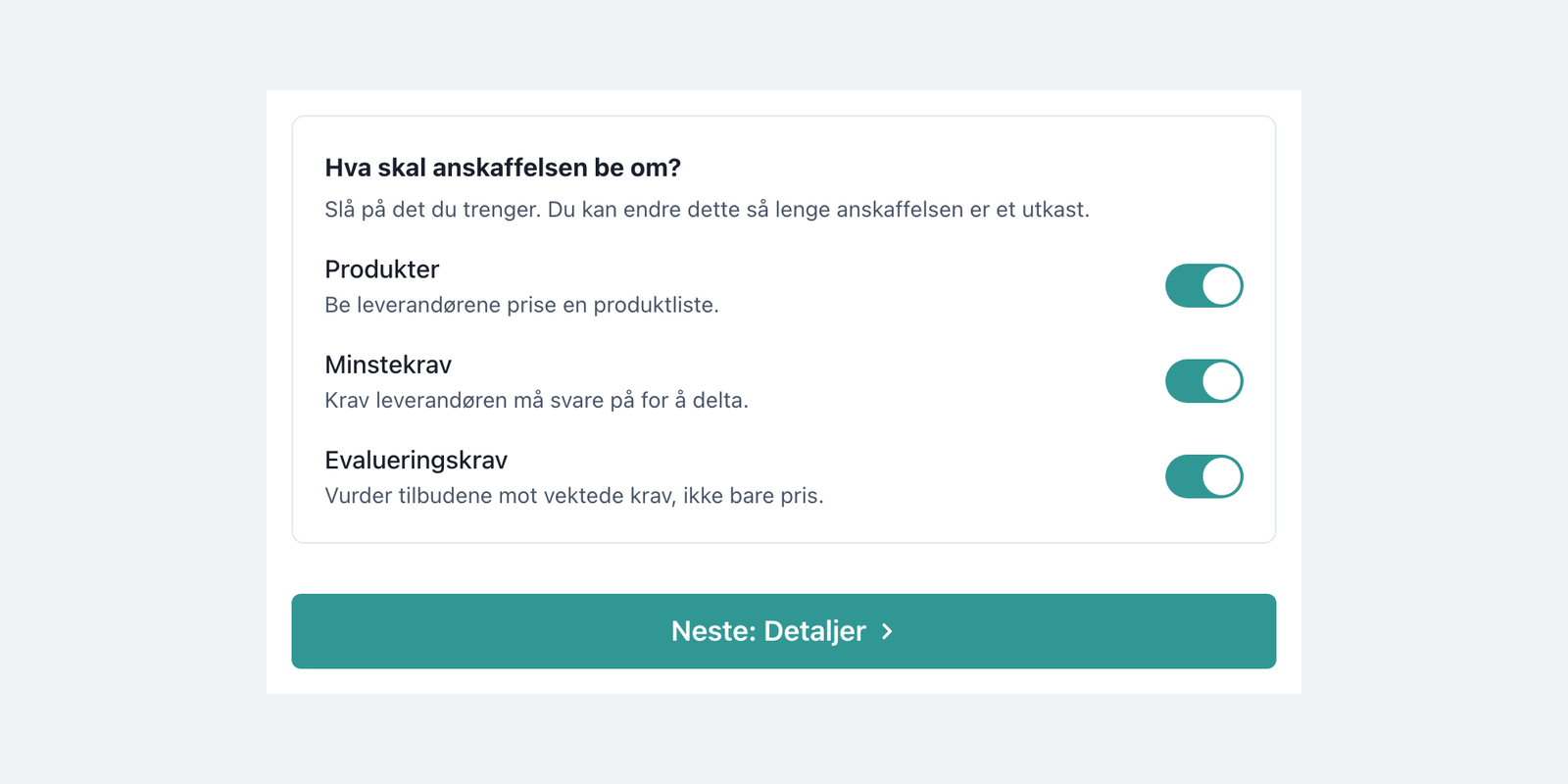
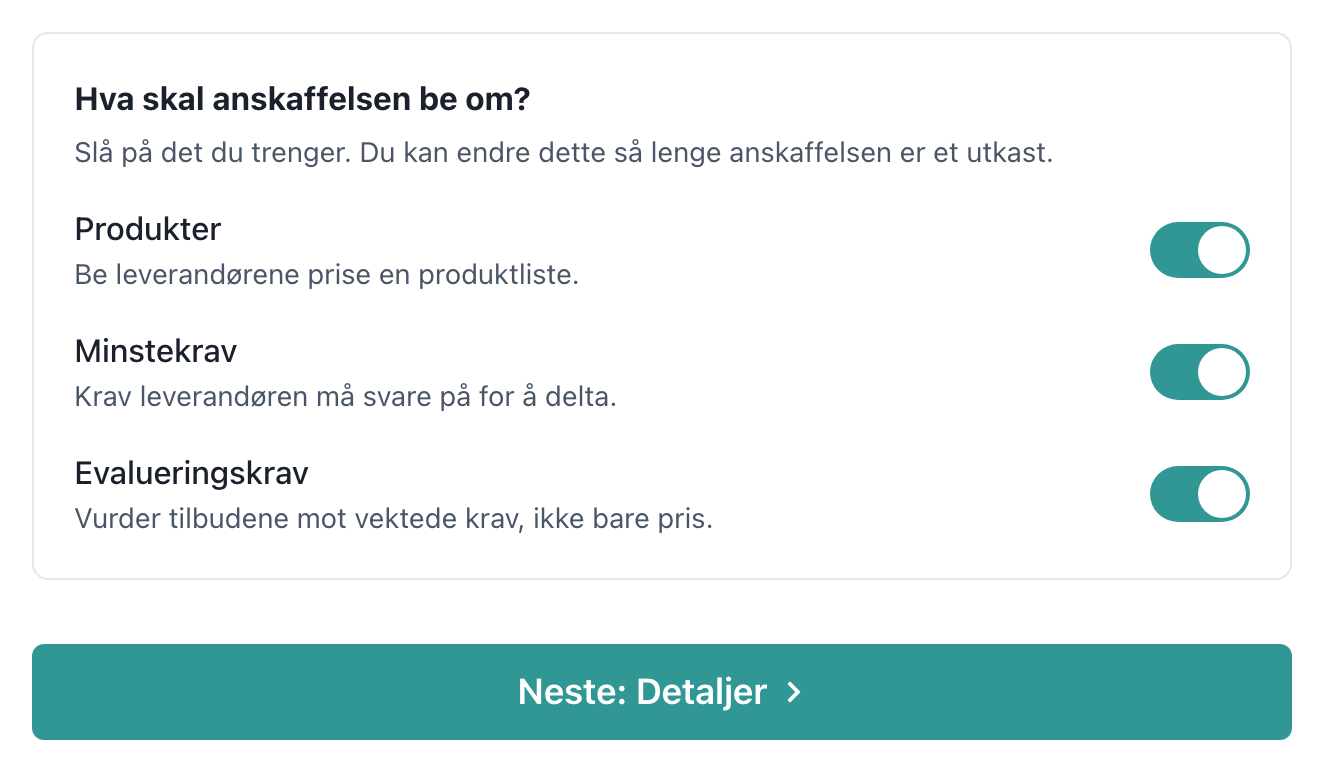
The first step of a new procurement asks a plain question — Hva skal anskaffelsen be om?, what does this procurement ask for. Three switches answer it.
Produkter asks suppliers to price a list of line items, when you know exactly what you are buying and want to compare line by line.
Minstekrav are the things a supplier must answer to take part at all.
Evalueringskrav let you score the bids against weighted criteria rather than on price alone.
Switch on only what this particular purchase needs and the wizard rearranges itself to match, adding or removing steps. A quick request for quotes stays a short form. A framework agreement with quality criteria and a priced product list becomes the full eight steps. You can change your mind for as long as the procurement is a draft.
Composing the procurement from three switches
Two kinds of requirements, kept apart
The distinction the tool now enforces is the one that decides whether an evaluation holds up.
You answer minimum requirements with a yes or a no — the supplier either has liability insurance of ten million kroner or does not. Some take a comment as well, where you want the supplier to explain. If a requirement is not met, the offer does not continue.
An evaluation requirement is scored. It carries a weight, and it can be split into sub-requirements when a single criterion is too coarse to score fairly — "quality of service delivery" broken into staffing plan, quality assurance, and the competence of key personnel.
Keeping the two apart stops the most common mess when comparing offers: a pass/fail condition quietly being awarded points, or a genuine trade-off being treated as a gate.
A requirement library you write once
Requirements now live in their own place, under Bibliotek → Kravbibliotek, split into three tabs with a count on each: Minstekrav, Evalueringskrav and Underkrav.
Dine krav are the ones your organisation has written. They are owned by you and visible only inside your organisation.
SourceMagnet-standard is a shared set that ships with the platform, there to start from when you do not want to write a requirement from scratch.
Pull them into a procurement instead of retyping them, and the wording stays consistent across everything you buy. That consistency is worth more than the time saved: when the same requirement is phrased the same way every time, supplier answers become comparable across procurements, not just within one.
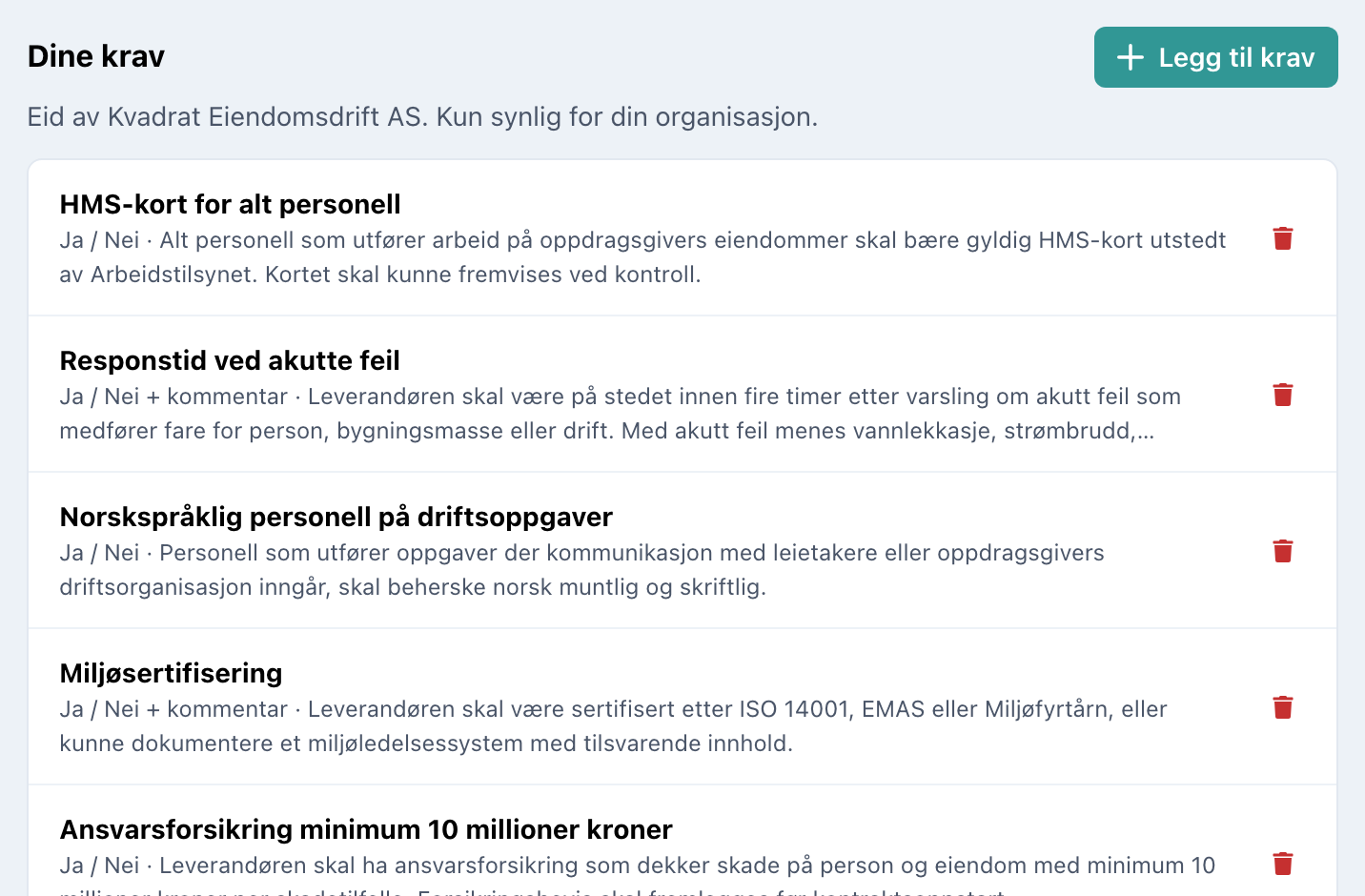
The requirement library
Templates for the whole setup
The requirement library gives you one requirement at a time. A template gives you the entire setup at once — requirements, criteria and settings together.
Templates sit under Bibliotek → Maler, and each one states what it contains before you open it: the contract type it is for, and its composition, such as 3 minstekrav · 3 evalueringskrav, or 1 minstekrav · Laveste pris.
Build one from scratch with Ny mal, or, more usefully, take one that worked and keep it with Lagre som mal. Next time you pull the whole set in with Bruk mal and adjust only what is specific to this purchase.
Two details worth knowing: only administrators can edit templates, so a standard setup does not drift; and editing a template does not reach back into procurements already created from it.
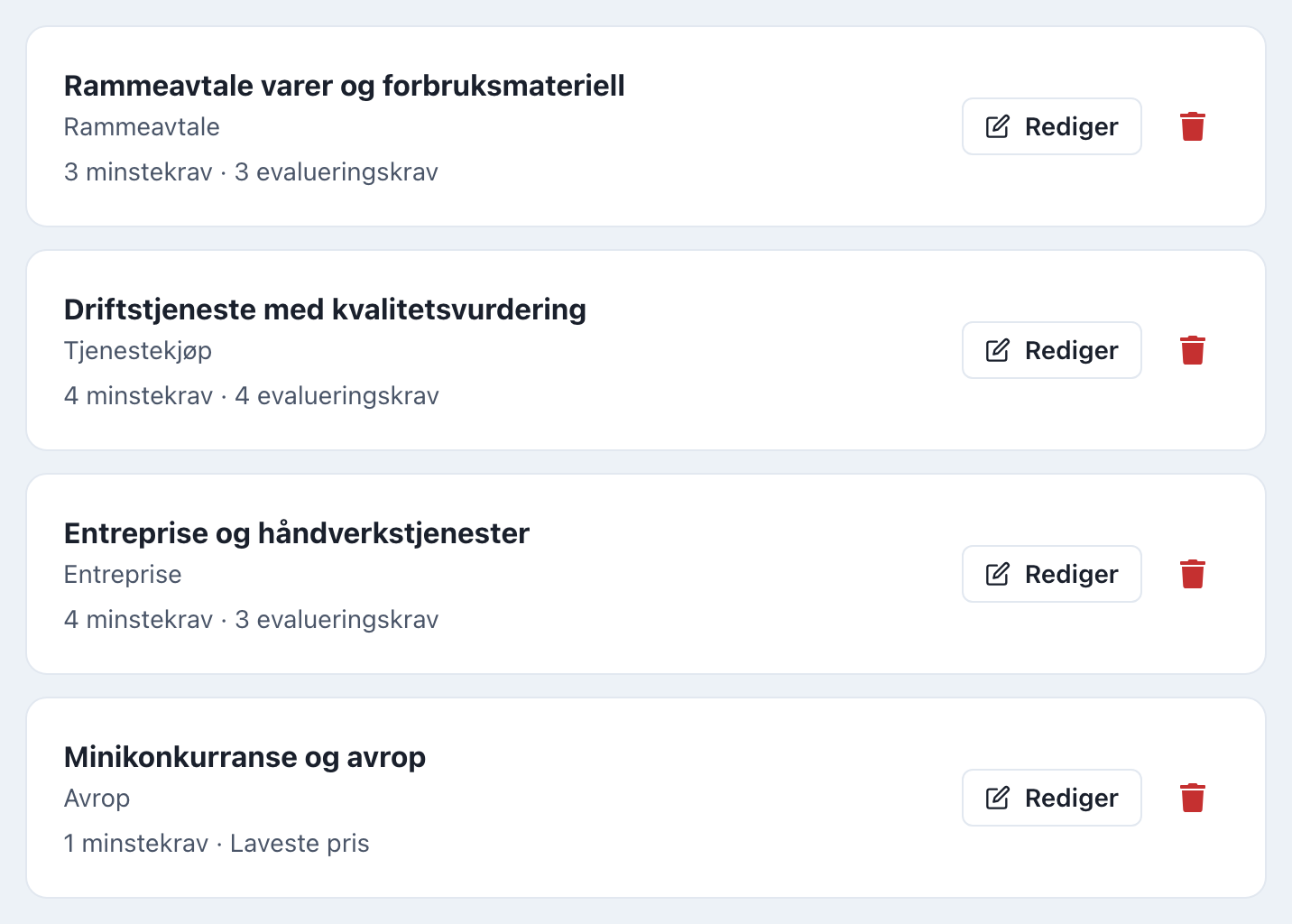
Templates carry the whole setup
Scoring that adds up
Choose how bids are judged — Laveste pris, or Beste forhold mellom pris eller kostnad og kvalitet — and the evaluation becomes a single table: criteria down the rows, suppliers across the columns.
The weighting is done for you. Each criterion shows both its own weight (vekt) and its effective weight (eff. vekt), so when quality counts 35 per cent and the staffing plan is 40 per cent of quality, the table states plainly that the staffing plan is worth 14 per cent of the whole decision. Nobody has to work out for themselves what a sub-criterion is really worth.
Price is calculated, not scored. The price row is marked AUTO and comes straight from the bids you receive. If you asked for a product list, the total is the sum of the priced lines.
Every score can carry its reasoning. Each cell takes a comment alongside the number, which is what you will want three months later when a supplier asks why they did not win.
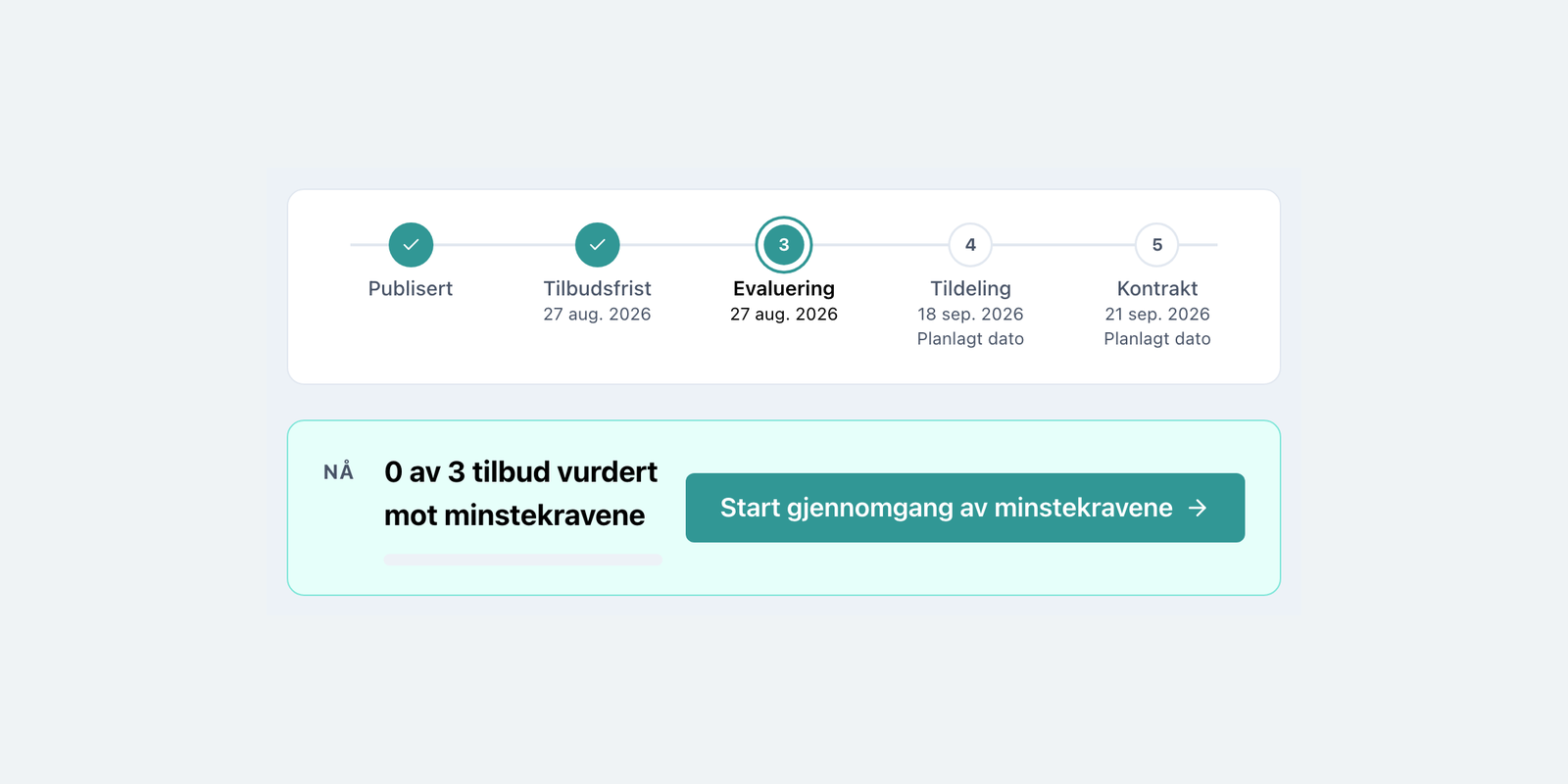
A counter tracks how many scores are in, and Fullfør evaluering locks them once the table is full. Total vektet score per supplier sits at the bottom.
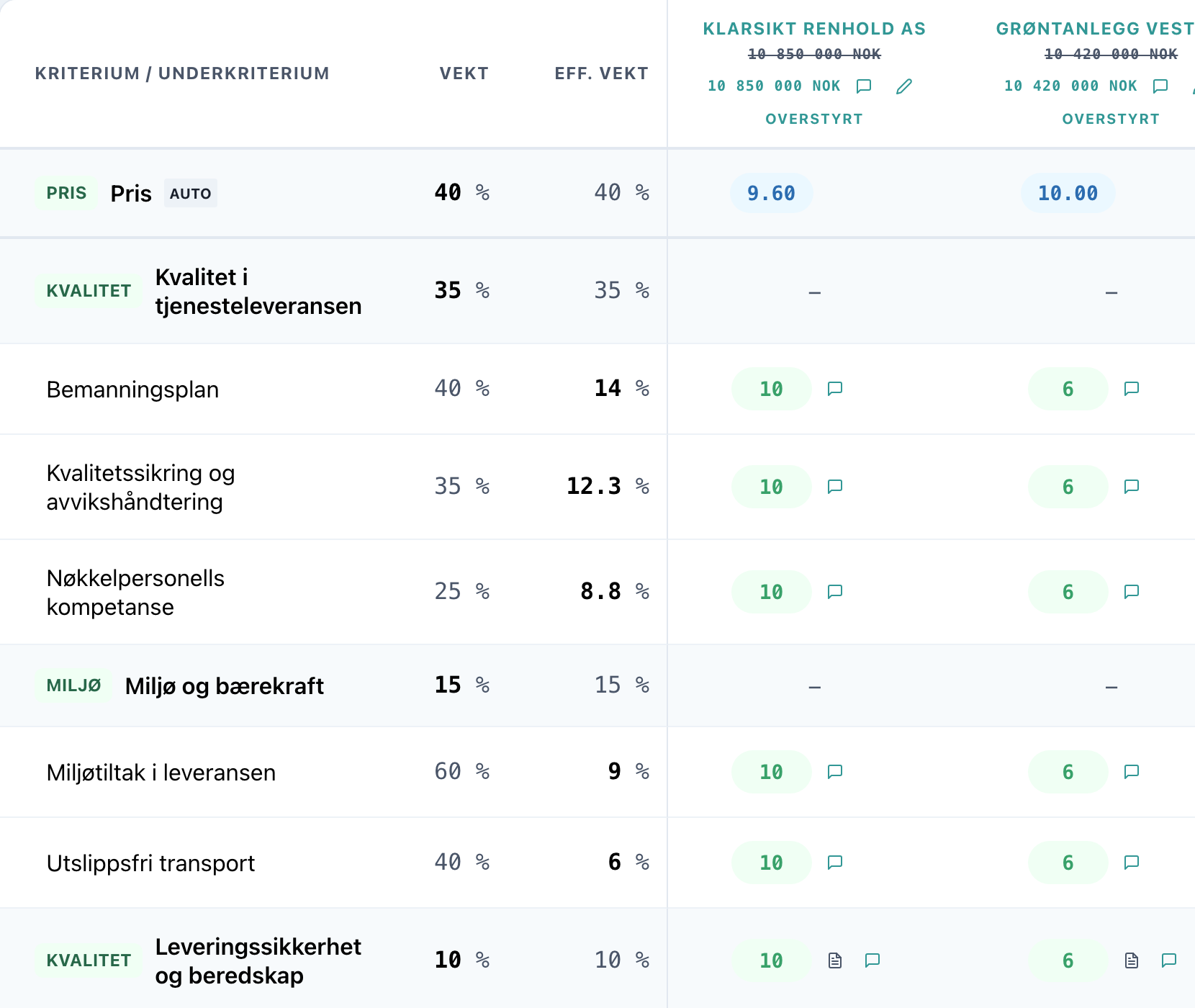
One weighted table for every offer
Award, then contract
Confirm the winner and the award page holds the outcome together: the awarded supplier, the agreed procurement value, and an internal note on why.
Letters are drafted per supplier — Tildelingsbrev til vinner and Avslagsbrev — and every one has to be approved before anything goes out. Send til alle leverandører then delivers them at the same time, so nobody hears the result second-hand.
From there, Gå til kontrakt creates the contract with the details from the procurement already filled in, and the agreement carries on under Kontrakter, where its deadlines and renewals are tracked.
The screenshots here show the Norwegian interface. SourceMagnet runs in Norwegian or English, and each user picks their own from the menu.
The new private sourcing flow reaches every SourceMagnet customer on Monday 7 September, at no additional cost. Our help centre covers each step in detail, and we are in the chat if you would rather just ask.